%20WHITE.png)

Wolves of Glendale Take Comedy Rock Somewhere Wilder on LP 'Go to the Woods'

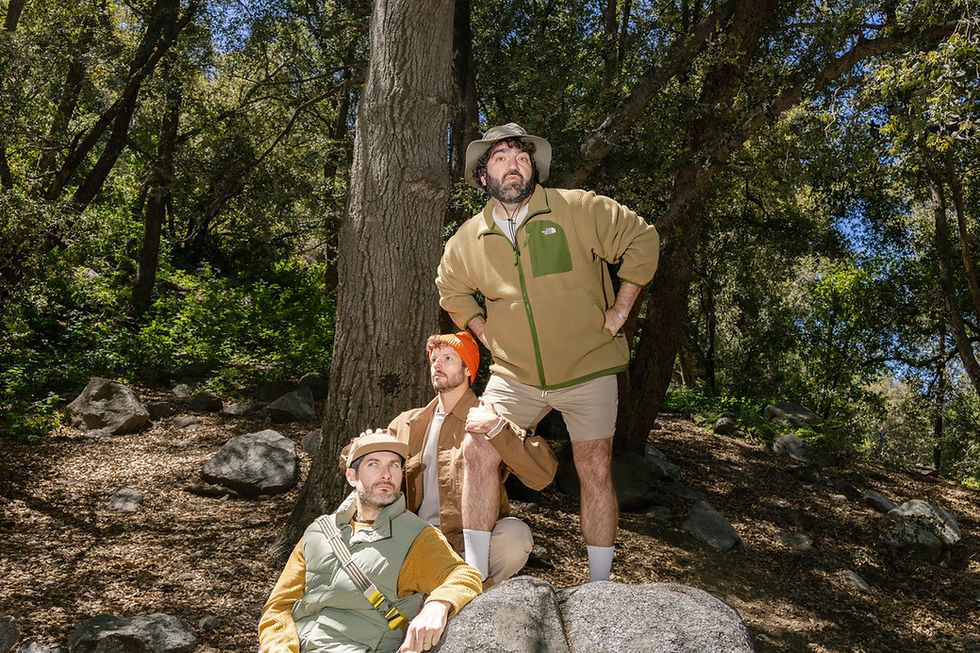
Wolves of Glendale have figured out how to make comedy rock hit like actual rock, and with their sophomore album Go to the Woods, the Los Angeles trio is pushing that formula into bigger, stranger territory.
Made up of Ethan Edenburg, Eric Jackowitz, and Tom McGovern, Wolves of Glendale have built a devoted following by pairing absurdist humor with seriously sharp musicianship. Their new 15-track album, produced by Grammy-winning producer John Spiker, pulls inspiration from horror movies, social anxieties, awkward encounters, and the everyday absurdities that probably shouldn't be songs, but somehow become massive hooks in their hands.
After taking their chaotic live show to stages including Bonnaroo, Lollapalooza, SXSW, and Netflix Is A Joke Festival, Wolves of Glendale are heading into their next chapter with plenty of momentum behind them.
Ahead of the August 28 release of Go to the Woods, we caught up with the trio to talk about building the new record, finding the line between a great joke and a great song, working with Spiker, and why comedy rock might deserve a little more respect.
Comedy rock can fall apart if either the joke or the music feels secondary. When you were making Go to the Woods, how did you know when a song was genuinely great versus just genuinely funny?
I'm obviously a little biased, because I think literally every song on this record rules. But when you look at the track list, even before hearing the songs, it's pretty easy to spot at least one that's just funny for funny’s sake. There's a song called "Donkey Kong Is My Therapist" that we only recorded because we were in tears in the studio singing "Donkey Konggggg is my therapistttttt" over some grungy riff that Ethan was playing. Then at some point we were like, “You know what, we should probably just record this.” And then we did. And that song is actually as dumb as it sounds.
But to answer your question, I think there's something genuinely great and funny about every single one of these songs. Our goal as a band is to make a song you could listen to without the lyrics and feel like you're listening to an incredibly well-produced modern rock song. I think we definitely accomplished that on this record.
There was a moment when I first heard a coherent mix of "The History of Popcorn" and I got goosebumps. I remember thinking it was so funny that I was getting goosebumps listening to my own band's song about a fake story of Vikings accidentally inventing popcorn after beheading a king. But I think that speaks to how much time and effort we spent making these songs sound as good as possible, and writing the best arrangements we possibly could, so the music can elevate the joke every time. And vice versa.
The album pulls from horror movies, social anxiety, awkward encounters, and the general absurdity of everyday life. What ridiculous real-life moment came closest to writing a song for you?
The first song that comes to mind is "Chicken Parm," because there have been more than a handful of times where the three of us have been eating chicken parm somewhere, and we look up from our plates and — as if it's the first time we've ever said it to each other — all vocally agree that chicken parm is just the greatest meal of all time. Eventually one of us was like, we should probably write a song about that. And "Chicken Parm" was born.
"I Finished a Book" is a close second, because personally, whenever I do finish a book, I feel like I just graduated from Harvard. I'm so bad at finishing books. So the initial joke in that song comes from a real place: doing something incredibly simple but feeling like I'm the man for pulling it off.
John Spiker has worked with artists like Tenacious D and Slash. What did he bring to Go to the Woods that pushed the sound beyond what you accomplished on your debut?
John was such an unbelievable part of this process. This album literally wouldn't be anything like what you're going to hear without him. He's a really unique swiss army knife of a producer and engineer, because he has a rare skill set: he's a genius behind the mixing console, able to record drums in the basement of a cabin in the woods and make it sound like a professional drum room in Los Angeles. But his instincts as a funny person are also invaluable to us as a comedy band. Having someone we can trust comedically and musically steering the ship during the recording process is something I really can't overstate. John was such an x-factor in this entire process.
Anytime the three of us were unsure of where to take a joke or what instrument to add to an arrangement to help elevate it, we could always turn to John and trust that his opinion was leading us in the right direction. And John was also just supportive of following us down the silliest rabbit holes possible. Can’t believe I;m bringing this song up twice in the same interview, BUT: with "Donkey Kong Is My Therapist," when we were like, hey, let's record that, he was immediately like, “Yeah, of course we've gotta record it.” And five minutes later he had Eric’s drums ready to go and Ethan’s guitar plugged in and my mic set up. And all of a sudden we had a new track just because John said yes the entire time, when I think it could have been very easy for an average producer to say “we don’t have time, that’s too stupid, let’s keep moving”.
So not only were we guided by an absolute seasoned professional, a monster engineer and producer, we were also made to feel like we could be our funniest selves and be embraced for it. In the record-making process I think comfort is number one, and John is the greatest at making incredible-sounding records in the most comfortable environment possible.
You've played everything from Bonnaroo and Lollapalooza to Netflix Is a Joke Festival. Do you notice a difference between winning over a music festival crowd and a comedy crowd, and which one is harder?
I wouldn't say either is harder, I just think they're different. A music festival crowd has been standing outside all day, they're there for the music, they're ready to party. So we're able to come out of the gate like Green Day or Blink, like a rock band at a festival would, and get everyone hyped up right away. We wouldn't necessarily do that at the Improv in LA.
For a comedy crowd, we can spend more time between songs riffing with each other, making each other laugh, and making the room laugh because of it. Then we're able to use our musical ability in that context to wow a comedy room in a different way.
The reverse is true at a festival. People expect to hear music, expect to hear a rock band play. But when we start singing about funny stuff, and when we're bantering and interacting with the crowd between songs, which can be relatively rare in a festival context, we've found that people really dig it.
That's what I think is really cool about the Wolves: we're able to offer something unique in both worlds, adjust to match the energy of the room, and still give an unforgettable show no matter what. The most common thing we hear, especially in a comedy context, is "Wow, the songs are actually good!!! I can't believe you can all sing really well and the songs actually sound good!!! You could write real songs if you wanted to!!!"
Comedy music has historically struggled to be taken seriously as "real music," even when the musicianship is undeniable. Do you think that perception is changing, or is being underestimated part of what makes Wolves of Glendale work?
Since we formed in 2022 we’ve been on a mission to prove this exact point: that comedy music should be held to a higher standard. It can feel like an uphill battle sometimes because of preconceived notions about what comedy music is. A lot of people think it's like, a stand-up comedian playing campfire chords on a guitar or ukulele, telling jokes over a basic chord progression. Everything we're doing is a direct challenge to that stereotype.
I have full faith that this generation of comedy music has the ability to remind people that comedy music is funny, but that it can and should be taken seriously, like Tenacious D and The Lonely Island did in the early 2000s. Because there are people like Kyle Gordon and OCT putting real, incredibly intentional effort into their songwriting, production, and arrangements to help elevate the joke, just like we are. That really does make me believe the perception is already changing.


