%20WHITE.png)

Free Under Fire Ignite Rock's Next Chapter with "Givin' My Lovin' A Shot" Ahead of Graffiti In The Garden

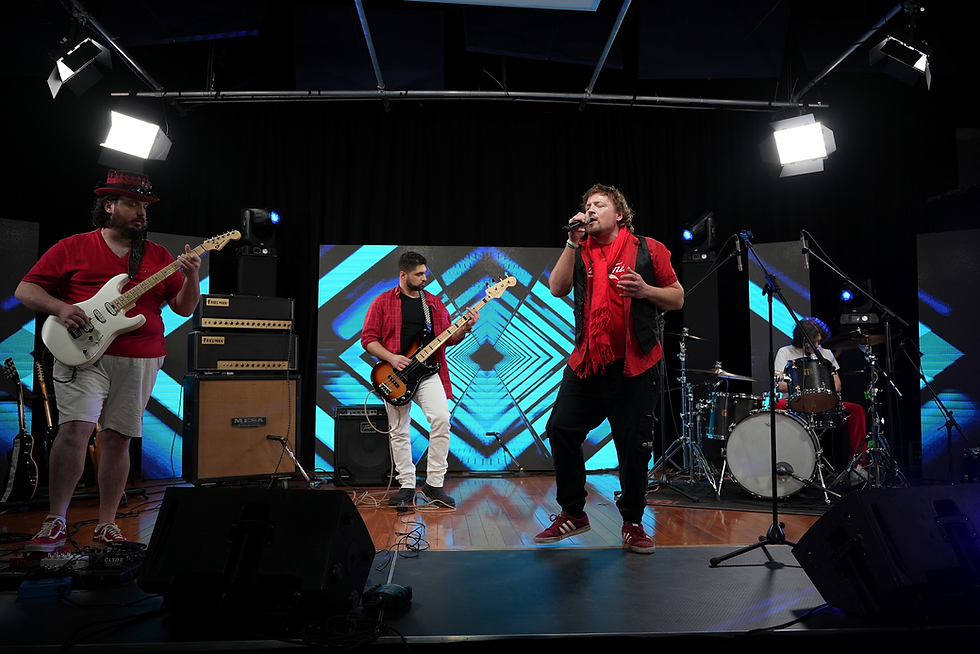
Free Under Fire aren't interested in chasing trends. On their latest single, "Givin' My Lovin' A Shot," the Ajax, Ontario rock outfit doubles down on the timeless energy that has defined rock's greatest eras while injecting it with a modern sense of urgency.
Built around soaring guitar work, driving rhythms, and a vocal performance that carries both grit and conviction, the single feels equally suited for late-night highway drives and packed festival stages. It's the kind of track that reminds listeners why loud guitars and honest songwriting continue to resonate long after trends come and go.
The release serves as the first taste of the band's upcoming third studio album, Graffiti In The Garden, arriving September 18. Rather than offering a collection of disconnected songs, the record promises an ambitious exploration of identity, ambition, regret, joy, and the contradictions that shape the human experience. The album's central metaphor, comparing life's permanent emotional marks to graffiti on a beautiful landscape, gives the project an emotional depth that extends well beyond its explosive rock instrumentation.
Free Under Fire have steadily built momentum through standout performances at NXNE, Deerfest, and Roots & Revival, proving that their reputation extends far beyond the studio. That live energy translates effortlessly into "Givin' My Lovin' A Shot," creating a release that feels immediate, confident, and unapologetically authentic.
With "Givin' My Lovin' A Shot" arriving August 13 and Graffiti In The Garden following shortly after, Free Under Fire make a compelling case that rock isn't making a comeback. It never left.
The title Graffiti In The Garden is incredibly visual. What inspired that metaphor, and how does it connect the album's songs into one larger story?
At its basis, the title of the record is juxtaposition. It's taking something that may be construed as vulgar in the common cultural milieu and combining it with something we implicitly, inherently hold sacred. In a way, it's a microcosm of the bigger thing it inhabits (our band and its name - Free Under Fire). It mirrors the name. Jung described the unconscious as wilderness - creative life. Perhaps the title is an attempt to subvert this framework; by intentionally desecrating sacred space, we attempt to gain some modicum of agency over our unconscious without the hard work typically required in probing dangerous internal spaces.
Enter the modern metaphor - be it cell phones at concerts in lieu of sitting in the moment and feeling what the song makes you feel, or anything else. The interpretations are as endless as the people who hypothesize them. But one thing to note is that both graffiti and garden are canvases for human expression. Whereas music is sound given orchestral form by people, so too is the garden a focus of our creative endeavours. We reap what we sow. It's the same thing when you attempt to weave a rock album together from the fabric of everyday life.
"Givin' My Lovin' A Shot" introduces this new era with a huge, energetic sound. Why did this track feel like the right first single to represent the album?
"Givin' My Lovin' A Shot" is certainly energetic and huge, but "Brand New Feeling" is actually the first official single (released June 4th of this year). It felt like the right single because it spoke to a universal phenomenon, namely, rising out of a bad mood and beginning to see all the joys in your life that you had previously disregarded. That's as close to a ubiquitous human experience as you can get. I mean, this may seem a strange comparison, but when you think about the Voyager capsule sent into space, the criteria was largely the same. In the unlikely (or perhaps very likely - equally daunting!) chance that extraterrestrials intercept the capsule, no matter what aspect of it they analyzed first, they would come face to face with an aspect of human intelligence, be it language, physiology or music, that represented as many people of planet earth as possible.
The songs on the capsule included songs like "Dark Was The Night, Cold Was The Ground" by Blind Willie Johnson - a nearly instrumental Delta Blues song that deals with not knowing where you're going to rest your head when night falls. That's a universal human experience. The hope for "Graffiti In The Garden" is two-fold - one - that lyrical content is still something that matters to people, and that they would connect not only musically but lyrically to songs, but - two - that it would serve as the entry point for our album.
I'm fully aware that there are certain songs on our upcoming album (releasing September 18, 2026) that may seem more esoteric thematically or lyrically, but the idea is that if a person has heard one song, connected with it and become interested in our band, then they would likely listen to other songs on the record that they may not otherwise give a chance to. Having a first single that maximizes this probability is a good strategic move.
Your recent performances at NXNE, Deerfest, and Roots & Revival have continued building your reputation as a live band. How has playing bigger stages influenced the way you approached this record?
I would say this record, above other records, has definitely shaped up to be a stadium album. Many of the songs are high energy, and even the ones that are more subdued definitely connect with larger and larger audiences. To be completely honest, we don't write songs for other people. We don't write songs for large crowds. We just naturally have gravitated towards a more high energy sound. People go to large shows to take part in the collective ecstasy - to witness a spectacle. On that front, we aim to deliver!
You describe the album as an exploration of the human condition, touching on ambition, regret, bliss, and self-reflection. Which song challenged you the most emotionally during the writing process, and why?
It's a strange thing. If you're honest with yourself and express yourself without reservation in your music, then you are a conduit. Nothing more, nothing less. It's really no different than someone who is not a musician living the emotions of their lives in real time. The only difference is I spend years looking for the chords, the themes, the lyrics, the melodies to give voice to mine. The emotional aspect of it isn't even the most arduous part. The enigmatic puzzle-piecing that experimental music (which is music that really entices me, personally) demands can be incredibly draining, emotionally. The difference between a good song and a great song is only about 10%. A little unorthodoxy here, a peculiarity there. It's all arbitrary on pen and paper. But that's the razor thin gap between a memorable, idiosyncratic work of art and a merely passable song. But that last 10% is what you strive a whole lifetime to meaningfully capture.
You've said you want listeners to walk away believing that rock music is still alive and that the rock album still matters. What do you think today's generation is rediscovering about rock that makes this the right moment for a record like Graffiti In The Garden?
Rock music, with all its multi-faceted sonic, landscapes, has not gone away. It has merely changed hands across the generations - from the exuberant, star studded rockers of the 1970’s, resplendent, in all the shining glory of rock’s supposed heyday – to the intricate daily fabric of our post-internet age. Rock has just changed forms, but the spirit the underpins great rock bands has never gone away. There's never been a better time than now for rock to come back. And we're happy to be a part of that revival.


