%20WHITE.png)

Major Artists Are Using AI. What Does It Mean for the Future of Music?


For the past few years, artificial intelligence has been treated like the music industry's dirty little secret. Artists condemned it. Labels warned about it. Fans accused musicians of using it whenever a vocal sounded slightly unnatural or a cover looked suspiciously polished.
Meanwhile, generative AI platforms continued improving at a ridiculous pace, becoming capable of producing vocals, instrumentals, arrangements, demos and, increasingly, entire songs. Now, something is changing.
Artists aren't simply experimenting with AI behind closed doors anymore. Some are openly admitting they use it, defending it and, in certain cases, questioning why anyone should care.
That shift became impossible to ignore this week.
Tyga Says He Used AI. He Also Says He Doesn't Care.
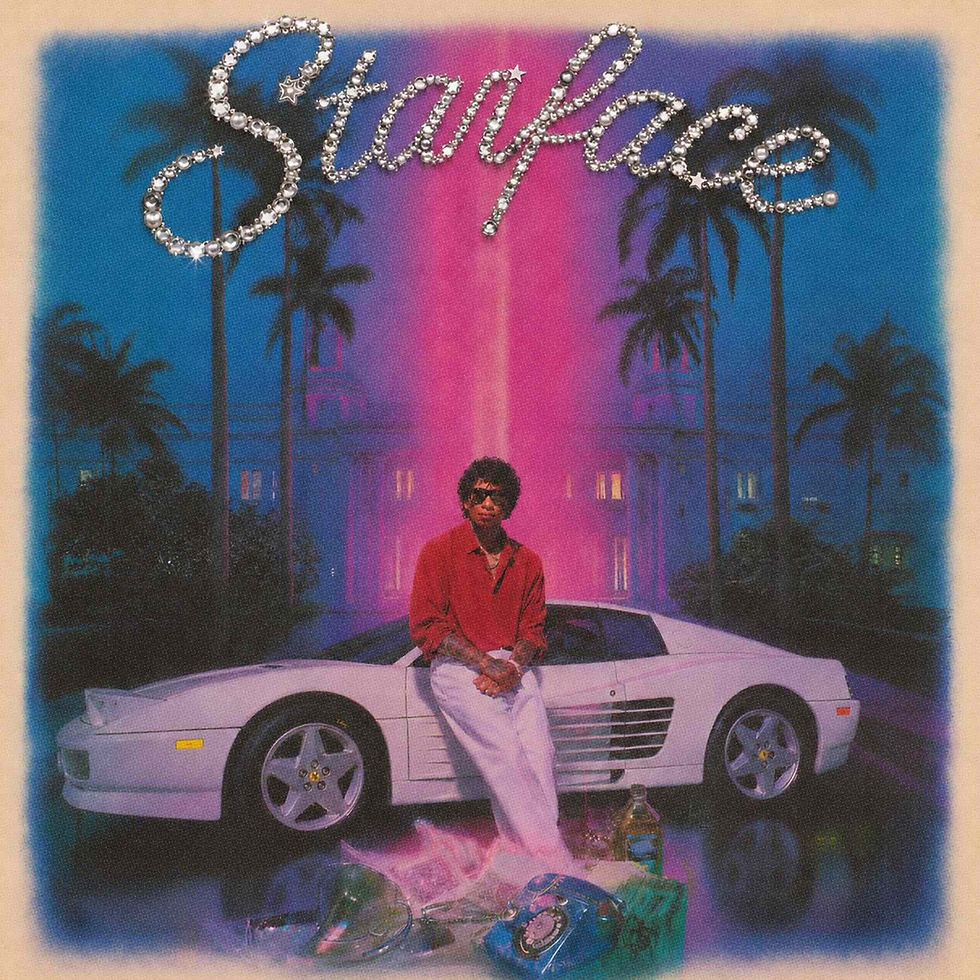
Tyga has confirmed that artificial intelligence played a role in the creation of his new album, $TARFACE. In an interview with VIBE, the rapper discussed using AI as part of the album's production process, particularly while developing its heavily '80s-inspired sound.
Rather than allowing AI to write his lyrics or replace his vocals, Tyga said he used the technology to help generate musical elements including synths and guitar solos. His argument is relatively straightforward: AI is a tool.
Tyga compared the backlash surrounding artificial intelligence to the reaction Auto-Tune received when it became prominent in popular music. Technologies that initially look like threats to musicianship can eventually become ordinary pieces of the production process.
And when it comes to potential criticism, Tyga isn't exactly losing sleep over it. "I don't care," he told VIBE while discussing the possibility that listeners might react negatively to his use of AI.
The distinction Tyga makes is important. According to him, the vocals are his. The lyrics are his. AI simply helped accelerate parts of the production process. That might sound considerably different from typing "make me a hit song" into a generator, but it also exposes the increasingly complicated problem with discussing "AI music." That phrase now describes wildly different things.
An artist using machine learning to clean up an old recording is technically using AI. So is a producer generating a guitar part. So is someone cloning another artist's voice. So is a person generating an entire song from a text prompt without playing a single instrument.
Treating all four as identical doesn't make much sense.
Then There's Fenix Flexin

The debate became considerably messier around Fenix Flexin's unexpected synth-pop hit "Rubberz." The Shoreline Mafia rapper's dramatic stylistic pivot raised eyebrows almost immediately. Instead of the West Coast rap associated with his catalog, "Rubberz" leaned into glossy '80s-inspired synth-pop, complete with an unusual vocal performance. Listeners started asking whether AI was involved.
Fenix initially pushed back against those accusations. But scrutiny intensified after producer Medasin investigated the track and highlighted evidence potentially connecting it to the generative music platform Treblo, formerly known as Sonauto. Treblo subsequently released an AI detection tool that identified "Rubberz" as very likely having been created using its model.
Fenix has since acknowledged AI's involvement while maintaining that he personally recorded the vocals and saying he only became aware of the AI component later in the production process.
The controversy matters for a reason that goes beyond one song. Listeners don't necessarily seem angry that technology was involved. A major source of the backlash has been uncertainty about what exactly was used and when. That distinction is probably going to define the next era of music. The issue may not simply be AI. It may be disclosure.
Empire of the Sun's Luke Steele Isn't Hiding It Either

While some artists remain cautious about attaching themselves to AI, Empire of the Sun's Luke Steele is going in the opposite direction. In a recent interview with iHeartRadio Canada, Steele openly confirmed that he uses AI, comparing the technology to an extremely intelligent guitar pedal.
His broader argument is even more revealing. Steele believes musicians who completely reject AI risk being overtaken by artists willing to understand and manipulate it. Whether you agree with him or not, that mindset is increasingly common.
The question is shifting from "Should musicians use AI?" to "How should musicians use AI?"
That's a dramatically different conversation.
Timbaland Has Gone Even Further

Few major producers have embraced the technology as aggressively as Timbaland.
Rather than quietly adding AI tools to his existing workflow, the legendary producer has made artificial intelligence part of his next business chapter.
Timbaland partnered with generative music company Suno and launched Stage Zero, an entertainment company centered around AI-created artists. Its first major project, TaTa Taktumi, arrived as an explicitly AI-generated artist.
That means we're no longer discussing AI merely assisting human musicians. We're talking about established producers building new "artists" around the technology itself. Timbaland has even argued that AI offers something contemporary music is currently missing, describing much of modern music as bland while positioning AI as a potential source of new creative energy.
It's a provocative stance coming from someone whose production credits helped shape decades of pop, hip-hop and R&B. But it also demonstrates how quickly the industry conversation has moved. AI isn't waiting outside the studio anymore. It's already sitting behind the console.
AI Has Already Appeared on Records From Legends
There is another side to this conversation that tends to get lost whenever "AI music" becomes shorthand for completely generated songs. The Beatles used machine learning technology to help complete "Now And Then," released in 2023.
John Lennon originally recorded the song as a home demo in the 1970s. When the surviving Beatles attempted to work with the recording in the 1990s, technological limitations made it difficult to properly separate Lennon's vocal from the piano and background noise.
Decades later, technology developed by Peter Jackson's WingNut Films team changed that.
Machine-assisted learning was used to isolate Lennon's actual vocal performance from the original recording. Paul McCartney and Ringo Starr could then build the finished record around a significantly cleaner version of his voice. That's a crucial distinction.
AI didn't write Lennon's lyrics or generate a fake Lennon performance. It helped engineers recover an existing human performance that previously couldn't be properly isolated. The result became the final Beatles song. Suddenly, declaring that "AI has no place in music" becomes a little harder.
Randy Travis Shows What AI Can Do When Consent Is Clear

Perhaps the strongest argument for AI-assisted music arrived through Randy Travis. The country legend suffered a devastating stroke in 2013 that severely affected his ability to speak and sing.
More than a decade later, AI helped make new Randy Travis music possible. For 2024's "Where That Came From," developers created proprietary AI models using vocal stems from Travis' career. Singer James Dupré provided the underlying vocal performance, while longtime Travis producer Kyle Lehning meticulously shaped the resulting AI-assisted vocal to resemble Travis.
Most importantly, Travis and his team approved the project. The technology wasn't being used to impersonate an unwilling artist. It was being used with the artist's participation to restore an ability he had physically lost. That makes the ethical equation radically different from an anonymous creator cloning Drake's voice and uploading a fake collaboration to Spotify. AI itself isn't making that distinction. Humans have to.
Imogen Heap Wants Artists to Own Their AI Selves

Imogen Heap has approached the issue from yet another direction. Instead of waiting for companies or strangers to create unauthorized versions of her voice, Heap intentionally developed her own private voice model, ai.Mogen.
Heap says the model has already appeared on other songs and can enable collaborations that might otherwise be impossible because of scheduling and time constraints. That idea could ultimately become one of the most significant developments in the entire AI debate.
If artificial versions of famous voices are inevitable, artists may decide the smartest move isn't preventing them from existing. It might be owning them.
Imagine an artist licensing an official voice model the same way they currently approve a sample, feature, or sync placement. Producers could request access. Artists could approve specific uses. Royalties could be attached. Unauthorized models could be distinguished from official ones.
The technology doesn't automatically have to remove artists from the equation. Potentially, it could create another asset for artists to control.
The Real Problem Is Becoming Transparency
There is an obvious difference between using AI to isolate a vocal recording and asking a generator to produce an entire song. There is also a difference between cloning your own voice and cloning someone else's without permission.
And there is definitely a difference between experimenting with AI in production and secretly releasing generated music while presenting every element as traditionally created. That's why the industry's obsession with determining whether something is simply "AI" or "not AI" is already becoming outdated.
The better questions are more specific. What did the AI actually do? Who trained the model? What material was used to train it? Did the people whose work or voices were involved consent? Which parts of the finished recording were created by humans? And does the listener deserve to know? Those questions aren't going away.
AI Music Isn't Coming. It's Here.
For years, the music business discussed artificial intelligence like some approaching technological storm. That framing no longer works.
Tyga is openly discussing using it on an album. Fenix Flexin is defending AI as part of modern music production. Luke Steele says artists who reject it risk being left behind. Timbaland has built an entertainment company around it. Imogen Heap has created a model of her own voice. Randy Travis used it to sing again. The Beatles used machine learning to finish a recording that had been sitting incomplete for decades.
These aren't anonymous Spotify accounts generating fake songs. They're established artists, producers and estates experimenting with different versions of the same rapidly evolving technology.
That doesn't mean every use of AI deserves acceptance. Far from it. There are enormous unresolved questions surrounding copyright, training data, compensation, consent and what happens to working musicians when labels can generate usable material in seconds. There is also something deeply uncomfortable about a creative economy where the recorded work of thousands of musicians could potentially train systems designed to reduce the need to hire musicians in the future.
Those concerns shouldn't be dismissed as artists simply being afraid of technology.
But pretending AI can still be kept completely outside the recording studio isn't realistic either. The line has already been crossed. What matters now is where the industry draws the next one. Because the most important debate in music may no longer be whether artists use artificial intelligence. It's whether they'll tell us when they do.