%20WHITE.png)

the della kit Builds a World of Her Own on ‘Dreams Speaking in Colour’


Vancouver and New York-based artist the della kit enters a new chapter with Dreams Speaking in Color, a self-directed album that expands her blend of R&B, jazz, hip-hop, and soul while placing creative ownership at the center of the project.
The release marks a significant evolution for the vocalist, producer, songwriter, and DJ formerly known as Erica Dee. While her 2022 debut, moonbeams + frequencies, was co-produced alongside AstroLogical, Dreams Speaking in Colour places the della kit firmly behind the controls, with the majority of its production shaped by her own hand.
That independence is audible across the album's ten tracks. Opening with “Rebirth,” the record immediately establishes its focus on transition and personal evolution before moving into the atmospheric “Falling Stars” and “Consumed.” “Pitfall,” featuring AstroLogical, introduces another dimension to the record's collaborative side, while “Stuck Boi” and “New Heights” push the project forward through shifting rhythms and the della kit's layered vocal approach.
Drawing from hip-hop, meditative R&B, jazz, and '70s analog soul, the della kit treats her voice as both storyteller and instrument. Stacked harmonies drift between dusty beats, Rhodes, soulful samples, live instrumentation, field recordings, and unexpected rhythmic turns informed by years behind the decks.
“This is the first record where I truly felt the freedom to be myself,” she says. That freedom extends beyond production. Dreams Speaking in Colour documents the difficult process of leaving limiting relationships, professional structures, and former versions of yourself behind. “Goodness,” featuring Junia-T, and “Real Time,” with Chris Sholar, bring ideas of connection and transformative love into focus, while the latter stretch of the album moves through “City Came Back” before closing with “Home in Heart.”
Collaboration remains essential to that world, with contributions across the project from Junia-T, Chris Sholar, AstroLogical, DIOMO of Re.verse, Samir El Bousaadi, Jenny Lea of IMUR, Nate Drobner, and others.
After a career that has taken her from teenage performances at British Columbia raves to stages across Brazil, Morocco, Europe, and North America, the della kit sounds less interested in arriving at a fixed destination than in embracing everything she has become along the way.
Dreams Speaking in Colour ultimately makes that multiplicity its strength. Across ten tracks, the album moves between rebirth, uncertainty, connection, independence, and finding a sense of home within yourself. For the della kit, the record feels less like an arrival than the beginning of a chapter entirely on her own terms.
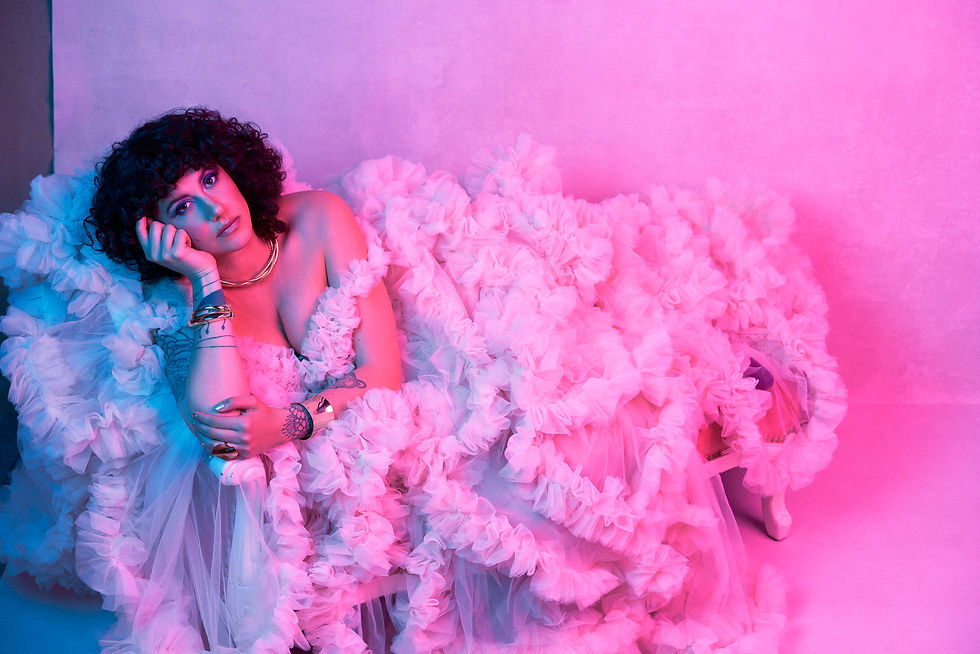
You’ve described Dreams Speaking in Colour as the first record where you truly felt free to be yourself. What did you have to unlearn or let go of before you could reach that freedom creatively?
This was the first project where I felt like I could follow my intuition and my instincts as a producer, songwriter, and vocal producer. I had to let go of the feeling that I wasn’t enough. The music industry can be full of people who want to keep you small.
For many years, I was the vocalist sitting behind a man running my sessions, but now I am the woman leading and producing everything. I had to start believing in my own capabilities and trust that my ideas were worth following. This is where my freedom came from; I stopped waiting for somebody else to tell me that I was ready and started trusting myself to be the artist and producer I knew I could be.
Producing the majority of this album yourself represents a major shift from moonbeams + frequencies. How did taking greater control of production change the way you understood your own voice as an artist?
The beautiful thing about the voice is that it is an instrument. Sometimes I hear an idea in my head that I can’t necessarily play, but I can still communicate that idea to my musicians and collaborators to bring it to life. Having people around me who believe in my vision as the producer is key.
I grew and learned so much throughout this project. I expanded my sonic palette, strengthened my communication skills, and learned that I was capable of guiding a team of people with Grammys and major accolades of their own. That was a huge part of stepping into my identity as a producer.
Your background as a DJ can be heard through the album’s beat flips, transitions, and rhythmic choices. How has DJing shaped the way you think about building an album rather than simply writing individual songs?
I love that you noticed that! My experience as a DJ taught me to think about the bigger picture, paying attention to tempo, genre, transitions, and how the songs will move together. I’m always thinking about how one song leads into the next, how the music translates on the dance floor, and how the overall energy can build and shift throughout the experience.
Much of Dreams Speaking in Colour deals with leaving relationships, professional structures, and older versions of yourself behind. Was there a particular song where that process felt especially vulnerable to put into words? Honestly, “Rebirth” was incredibly vulnerable to write because I was exposing something very real while I was still living through it. Being honest about my feelings while I was still sorting through them, and putting that truth out into the world before I had any resolution, felt incredibly raw. I felt naked in a way. I think a lot of people protect themselves by keeping certain parts of themselves hidden, and I wanted to do the opposite.
You’ve spoken about wanting femmes and queer artists to trust their voices and take up space without waiting for permission. What do you wish someone had told you earlier in your own journey about claiming that creative authority?
I spent a very long time being the only woman in predominantly male spaces, especially in the electronic music festival and DJ scenes. There were definitely moments where I was made to feel less than and small. It took me a lot of time and dedication to build confidence in my skills.
That confidence gave me permission to take up space and lead. I did have to put in the work and learn my craft, but I didn’t need to wait for someone else’s approval to validate me. Though I wished someone had told me “You belong here”. That never happened! Instead, I’ve grown into the woman who affirms herself. I AM ENOUGH!!!


